
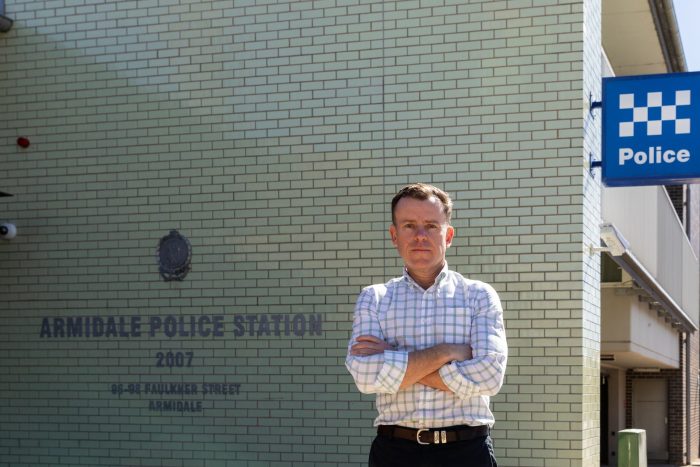
Member for Northern Tablelands Brendan Moylan spoke in Parliament last week to call on the government and departments to look outside Australia for solutions to the scourge of domestic and family violence.
The MP referred to the release of the most recent Bureau of Crime Statistics and Research (BOSCAR) figures which continue to paint a grim picture of rates of domestic violence.
Calling for fresh solutions to reduce domestic violence, he outlined successful approaches undertaken in Australia, Spain and Sweden.
“I was disappointed to see that Armidale, Inverell and Gwydir shires all have rates of domestic violence approximately twice the state average, Glen Innes is at 1.6 times the State average and Moree is at more than three times the State average,” Mr Moylan said.
“Domestic violence is a scourge on our society and we need to do more to address it.
“In my electorate, we are fortunate to have many excellent organisations doing great work, such as the Women’s Shelter Armidale, amongst many others.
“Too often in politics, when confronted with a difficult problem, we look only within our own borders for solutions. We tweak existing programs, adjust existing policies and hope for a different result.
“I believe that some of the most valuable lessons to address domestic violence lie outside of Australia.”
The MP said that in Austria, policymakers adopted a simple principle that shifted the focus of the entire system: The victim stays; the offender leaves. It is known as “whoever hits, leaves”.
“So rather than expecting victims and their children to uproot their lives, police immediately remove violent offenders from the home and connect victims directly and immediately with specialist support services,” the MP said.
“Importantly, interventions are also directed towards perpetrators, recognising that reducing violence often requires changing behaviour.”
In Spain, leaders recognised that domestic violence cases are unlike any other. They established specialised courts, dedicated prosecutors and integrated support systems designed specifically to deal with domestic violence matters. The goal was not simply to punish offenders but to create a system that victims could navigate safely and confidently.
In Sweden, policymakers asked a different question altogether. Instead of focusing only on what happens after violence occurs, they concentrated on how to prevent it from occurring in the first place.
“In Sweden, they have invested heavily in education, early intervention and programs aimed at boys and young men, they have sought to challenge harmful behaviours before they become entrenched and to change social attitudes before police or courts ever become involved” the MP said.
“What is striking about those examples is not that one country found a miracle cure; it is that each was prepared to move beyond their traditional approach.
“They treated it as a whole-of-society challenge that required innovation, coordination and long-term thinking and we must also become better at preventing violence before it starts.
“We need better integration between police, courts, health services and community organisations, and we need tough and appropriate sentences for perpetrators.
“Perhaps most importantly, we need the courage to examine ideas that have shown promise elsewhere and ask whether they might work her in NSW.
“If we are serious about reducing domestic violence in New South Wales—and I know that everyone in this Parliament is—we must be prepared to look at what works elsewhere and to think outside the box.”
Key domestic violence support services in NSW include the NSW Domestic Violence Line (1800 656 463), 1800RESPECT (1800 737 732), Full Stop Australia (1800 385 578), 13YARN (13 92 76), and various NSW Government and community services offering crisis support, counselling, safety planning, and referrals.